Effective Strategies for SHRM CP Situational Questions in 2026
· based on the channel PrepSolution
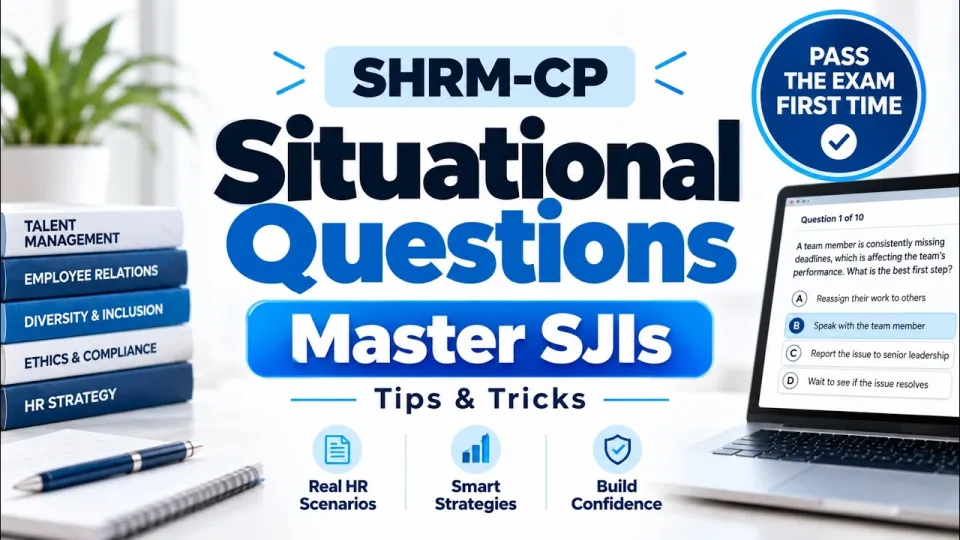
SHRM CP Situational Questions require candidates to analyze workplace scenarios and select the best response among multiple plausible options. Success in these Situational Judgment Items (SJIs) depends on understanding the question’s intent, applying HR principles, and avoiding common traps. Access free SHRM CP practice questions and resources at PrepSolution’s free SHRM-CP practice site to enhance your exam preparation.
Understanding SHRM CP Situational Judgment Questions
Situational Judgment Questions assess your ability to handle realistic HR scenarios by evaluating your judgment on policies, legal compliance, escalation, and interpersonal dynamics. Unlike knowledge-only questions, SJIs focus on decision-making processes and practical HR intervention.
Key to mastering these questions is recognizing whether the query asks for the next step in a process or the most effective action to resolve the issue. This distinction influences your answer choice significantly and aligns with HR’s role in supporting both employees and management.
Five Essential Decision Checks for Choosing the Right Answer
When approaching SHRM CP situational questions, use these five decision checks to evaluate each answer option:
- Facts: Analyze the details given without assumptions. Answers must align strictly with the scenario facts.
- Policy and Law: Ensure the option complies with organizational policies and legal requirements.
- Appropriate Escalation: Determine if involving higher management or HR is warranted or if it’s premature.
- HR’s Role: Choose actions that reflect HR’s supportive and advisory functions rather than taking over managerial responsibilities.
- People Involved: Consider who should be included in the resolution process to maintain fairness and transparency.
Applying these checks systematically helps to eliminate answer traps and focus on the best response.
Common Answer Traps to Avoid in SHRM CP SJIs
SHRM CP situational questions often include tempting but incorrect options designed to test critical thinking. Recognize these five common traps:
- Premature Action: Acting too quickly without gathering enough information or following protocol.
- Passive Responses: Avoiding necessary confrontation or failing to address the issue adequately.
- Taking Over Manager Responsibilities: Overstepping HR’s role by making managerial decisions.
- Unnecessary Escalation: Escalating issues that can be resolved at a lower level.
- Legally Defective Options: Choosing actions that violate laws or company policies.
Identifying these traps is crucial to narrowing down the correct answer.
Practical Tips for Eliminating Wrong Answers
Instead of relying solely on personal workplace experience, test each answer against the scenario’s wording and facts. Steps include:
- Re-read the question to confirm what is being asked: first step or best overall solution.
- Cross-check each answer with the five decision checks.
- Eliminate options that conflict with key facts or policy.
- Avoid answers reflecting common traps.
- Choose the option that aligns with HR’s facilitative role and legal compliance.
This disciplined approach improves accuracy and confidence in your selections.
Applying the Method to a Sample Scenario
Consider a situation where a supervisor asks HR to discipline an employee after a shouting match. The best response involves gathering all facts, understanding the context, and coaching the supervisor on appropriate conflict resolution rather than immediately imposing discipline or escalating unnecessarily. Comparing all four answers against the decision checks reveals which option maintains fairness, follows policy, and supports effective HR practice.
Useful Resources for SHRM CP Preparation
- Free SHRM-CP Practice Questions for hands-on scenario practice
- PrepSolution’s SHRM-CP Complete Pass System for comprehensive exam prep
Итог
Mastering SHRM CP situational questions requires understanding the question’s intent, applying five decision checks, and recognizing common answer traps. Using elimination strategies grounded in facts and policy helps select the most appropriate HR action. The detailed explanations and practice questions from the PrepSolution channel provide practical guidance to sharpen your situational judgment skills. For effective exam preparation, explore their free practice resources and tailored study systems.
Useful Links
- https://prepsolution.com/free-practice/shrm-cp?utm_source=youtube&utm_medium=video&utm_campaign=shrmcp_longform&utm_content=cp_long_v09
- https://prepsolution.com/exam/shrm-cp?utm_source=youtube&utm_medium=video&utm_campaign=shrmcp_longform&utm_content=cp_long_v09
Key takeaways
- SHRM CP Situational Judgment Items (SJIs) test HR decision-making skills
- Five key decision checks guide the best answer selection
- Common traps include premature action and unnecessary escalation
- Distinguish between first step vs. most effective action in scenarios
- Practice with realistic questions improves exam success
Source: SHRM CP Situational Questions (SJIs) | TIPS TO PICK THE RIGHT ANSWER · Markdown version
Questions & answers
What are SHRM CP Situational Judgment Items (SJIs)?
SJIs are exam questions that present workplace scenarios requiring candidates to choose the best HR-related response among multiple options, testing practical decision-making skills.
How can I distinguish between the first step and the most effective action in SHRM CP questions?
Carefully read the question to determine if it asks for the immediate next step in a sequence or the action that best resolves the issue overall, then select the answer accordingly.
What are common traps to watch for in SHRM CP situational questions?
Common traps include premature action, passive responses, taking over managerial duties, unnecessary escalation, and choosing legally noncompliant options.
Where can I find free SHRM CP situational judgment practice questions?
PrepSolution offers free SHRM-CP practice questions and resources at https://prepsolution.com/free-practice/shrm-cp?utm_source=youtube&utm_medium=video&utm_campaign=shrmcp_longform&utm_content=cp_long_v09.